
Panel Stresses Childcare and Early Learning Are Economic Infrastructure — and Everyone’s Business
Childcare is often treated as a private family struggle: a household stretching to afford the cost, parents searching for an open spot near home, a paid caregiver scrambling to make ends meet. But as CFHV's recent Childcare as Economic Infrastructure panel and Voices of the Hudson Valley listening work made clear, the challenge is far larger than any one household. Reliable, affordable early learning helps parents stay in the workforce, helps employers retain talent, strengthens the regional economy, and gives children the foundation they need to thrive in school and beyond.
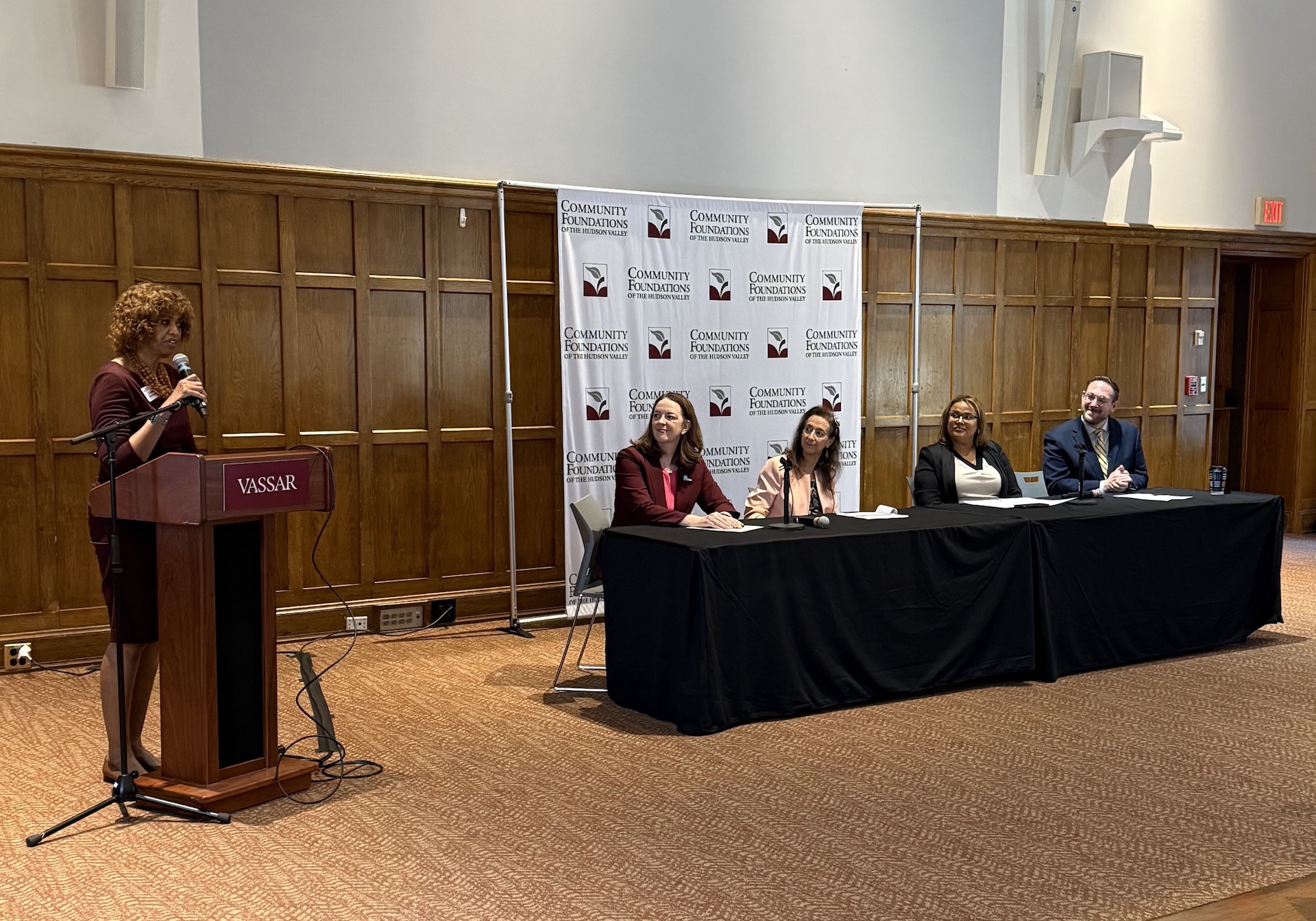
The June 1 panel conversation revealed both a system under strain and a region with the knowledge, partnerships, and will to respond. Kicked off by Dutchess County Executive Sue Serino, moderated by Jill Gomez, Executive Director of the Poughkeepsie Children's Cabinet, and held in partnership with Hudson Valley Economic Development Corporation, the discussion underscored that progress will depend on coordinated action across sectors.
Five Key Takeaways
1. Childcare and early learning are key to the Hudson Valley’s economic success.
Speakers repeatedly framed childcare as essential to workforce participation, hiring, retention, productivity, and regional growth. When care is unavailable or unaffordable, parents cut hours or leave jobs, employers lose workers, and children miss early learning experiences that shape long-term outcomes. “The question is not whether we pay. The question is whether we pay proactively through investment, or reactively through lost economic opportunity,” stressed Madeline Henriquez, Executive Director of DAY ONE Early Learning Community.
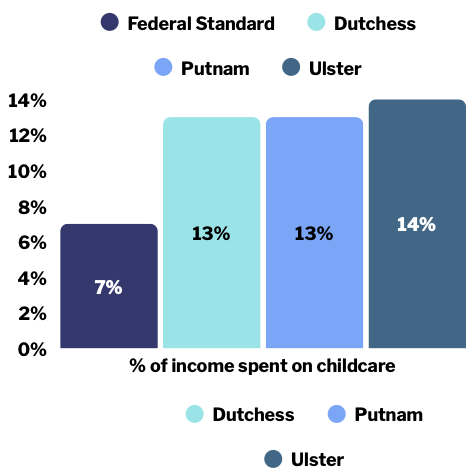
Percentage of Income Spent on Childcare
Source: Voices of the Hudson Valley (2025)
2. The Hudson Valley has a serious supply-and-affordability gap.
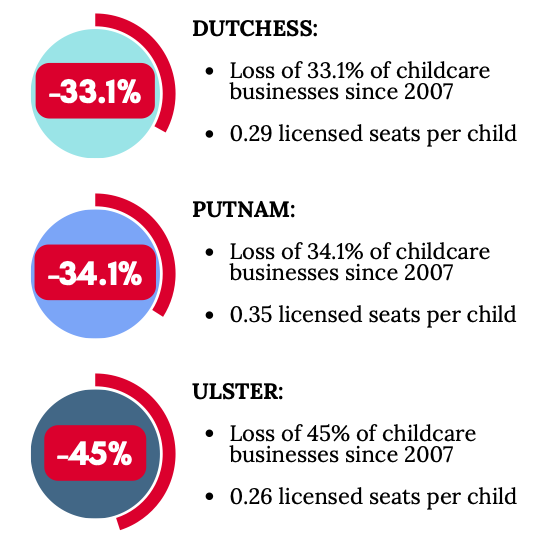
"In the Hudson Valley, families are balancing high costs, long commutes, and limited options for childcare," said Sarah Lee, Executive Vice President of Strategic Initiatives at the Hudson Valley Economic Development Corporation. The region has lost a significant share of childcare businesses over the past 20 years and there is only about one licensed slot for every three children. The average annual cost of childcare in the region was cited as roughly $12,000–$15,000 — more than annual SUNY tuition in some cases.
3. Recent pilot funding is important, but not enough on its own.
Dutchess County's state pilot funding—$20 million per year for three years to expand capacity for children ages 0–3 by about 1,000 seats—is a major opportunity, but only a start. "The state funding is a catalyst. We must take that opportunity to move the agenda forward," cautioned Sabrina Jaar Marzouka, Commissioner of the Dutchess County Department of Community and Family Services. Long-term sustainability will require investments that reflect the true cost of early childhood education, from competitive educator wages and facilities support to business assistance, workforce pipelines, and local partnerships that can continue after pilot dollars expire.
Loss of Childcare Providers
Source: Voices of the Hudson Valley (2025)
4. The early learning workforce crisis is central to the childcare access crisis.
"Seats don't teach children—educators do," emphasized Henriquez. Expanding access requires better career pathways, apprenticeships, higher education partnerships, compensation models, and support for home-based providers and small childcare business owners. The field needs to be treated as both education and entrepreneurship.
5. The most promising solutions are collaborative, local, and flexible.
Examples included employer-supported, 24/7 childcare from Vassar Brothers Medical Center—in partnership with DAY ONE and Hudson River Housing—and flexible training pathways through Dutchess Community College, supported by outreach to grassroots community groups. The panel's strongest message was that no single sector can solve the problem alone; government, employers, philanthropy, higher education, providers, and families all have a role to play. "It's not enough to say, 'We support employees with kids,'" said Christopher White, Vice Chancellor for Workforce Development and Upward Mobility at the State University of New York. "It has to be: 'Yes, we support employees — and here's how.'"
Read More
Community Foundations of the Hudson Valley, “Pressing Needs: Childcare,” in Voices of the Hudson Valley, 22–23 (2025).
Hudson Valley Economic Development Corporation, “Childcare Is the Hidden Economic Infrastructure,” May 2026.
Support Fund for the Hudson Valley
Your gift supports a nonprofit ecosystem addressing health and mental health, housing, food security, education and childcare, arts access, and more. Vetted by our professional grantmakers and county advisory committees, this fund does more than support individual nonprofits — it invests in a stronger region built on collaboration and lasting impact across our communities.
Explore a bigger impact: Email development@communityfoundations.org to open your own personalized fund.


